Dynamic Mechanical Analysis Spectroscopy
DMA Spectroscopy
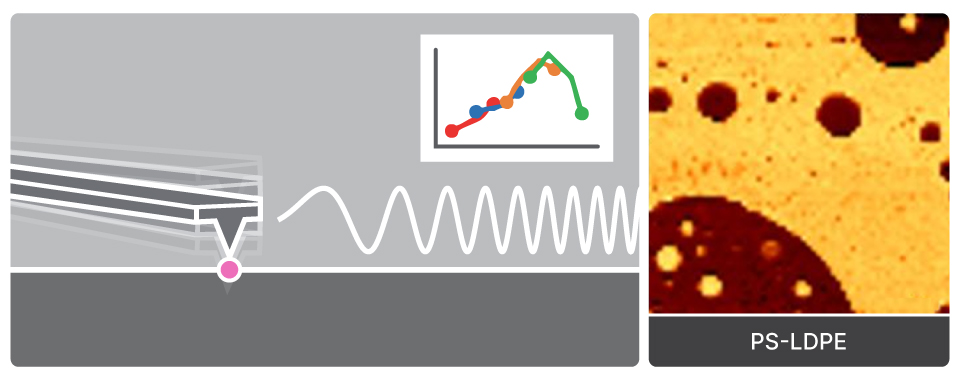
Nanoscale viscoelastic property measurement by applying oscillatory forces via the AFM cantilever and analyzing the frequency-dependent mechanical response
What is DMA spectroscopy
(Dynamic Mechanical Analysis Spectroscopy)
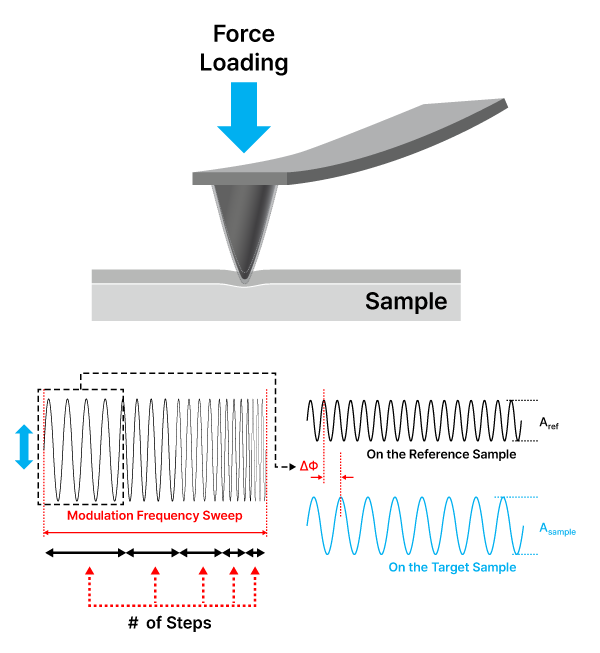
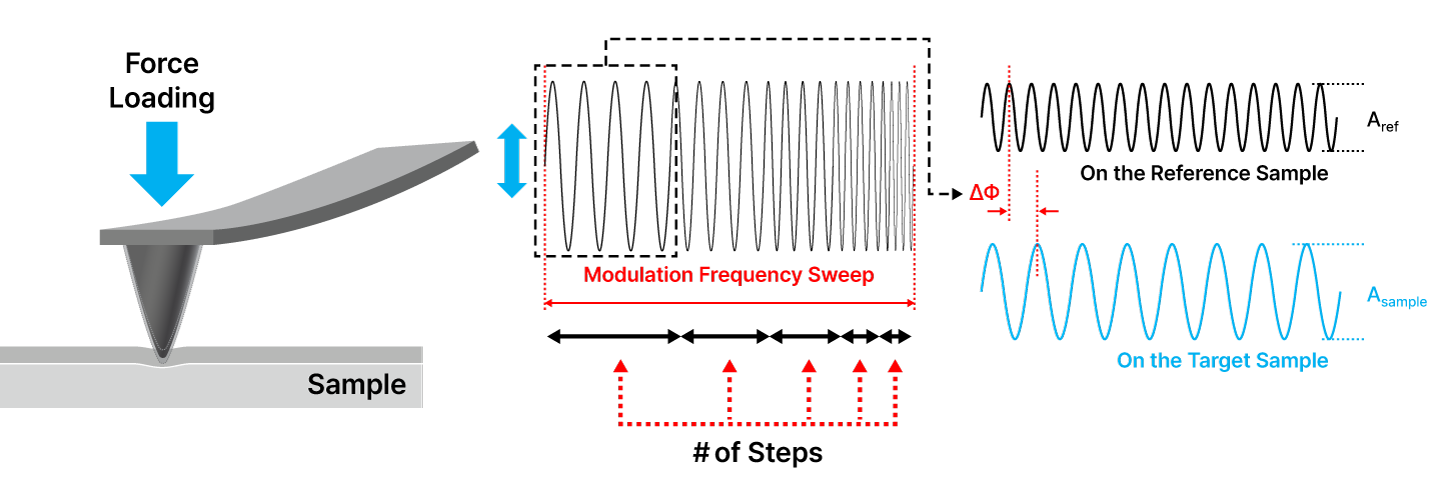
DMA spectroscopy measures viscoelastic properties by applying oscillatory forces via the AFM cantilever, making it widely applicable for characterizing the mechanical behavior of polymeric and soft materials.
Unlike conventional bulk DMA, which provides averaged values over large sample volumes, AFM-based DMA uses an AFM tip to apply a controlled oscillatory force directly to specific regions, enabling localized mechanical mapping. A sharp AFM tip is brought into contact with the sample surface and oscillated at a series of frequencies. The frequency-dependent response of the material is recorded by monitoring cantilever deflection and phase lag. These parameters allow for the direct calculation of local loss tangent (tan δ), a key parameter describing viscoelastic behavior.
Reasons to Use This Mode
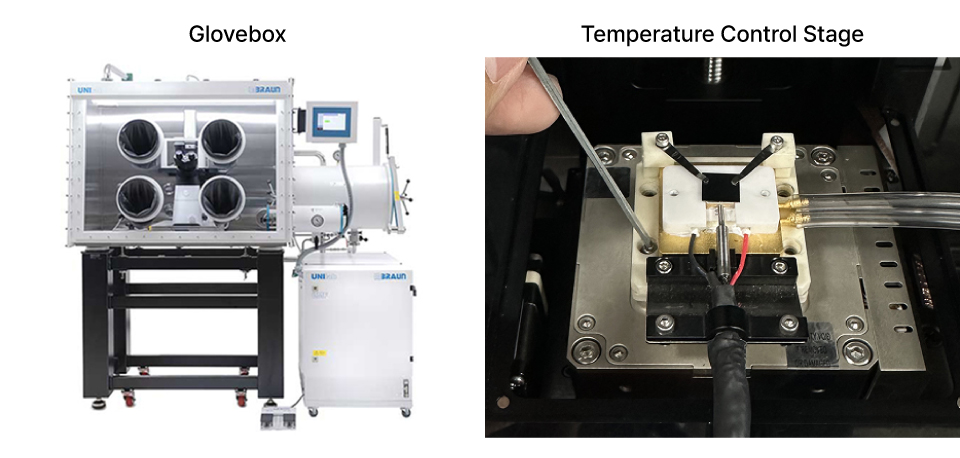
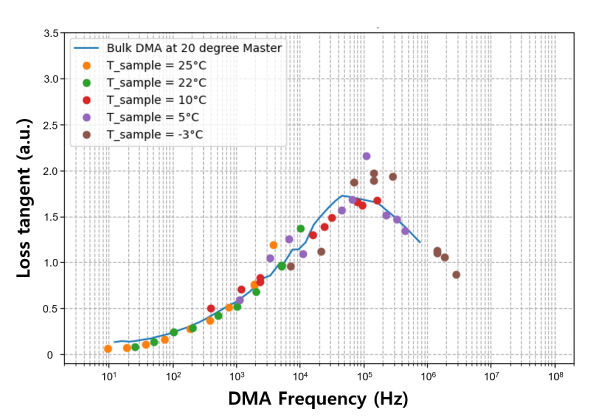
A unique strength of Park’s nano DMA is the ability to construct a "master curve." By applying the principle of time–temperature superposition, data collected over a range of temperatures can be shifted along the frequency axis to create a unified curve. This enables prediction of long-term viscoelastic responses and material performance under conditions outside the directly measured window, such as very high frequencies (fast stress) or very low temperatures (slow, aging processes). Particularly Park's nano DMA is compatible with advanced temperature control stages, permitting precise modulation of sample temperature—including sub-zero conditions. Coupling this capability with controlled glovebox environments, which actively regulate oxygen and humidity to eliminate condensation, enables reliable viscoelastic characterization across a wide range of environmental extremes. This integrated approach uniquely positions nano DMA as an ideal platform for probing nanoscale mechanical properties in polymers, elastomers, and other sensitive materials under conditions unattainable with conventional bulk DMA systems.
Environmental Control; Capable of Sub-Zero Operation
Master Curve Construction via Time–Temperature Superposition on SBR
Applications and Use Cases
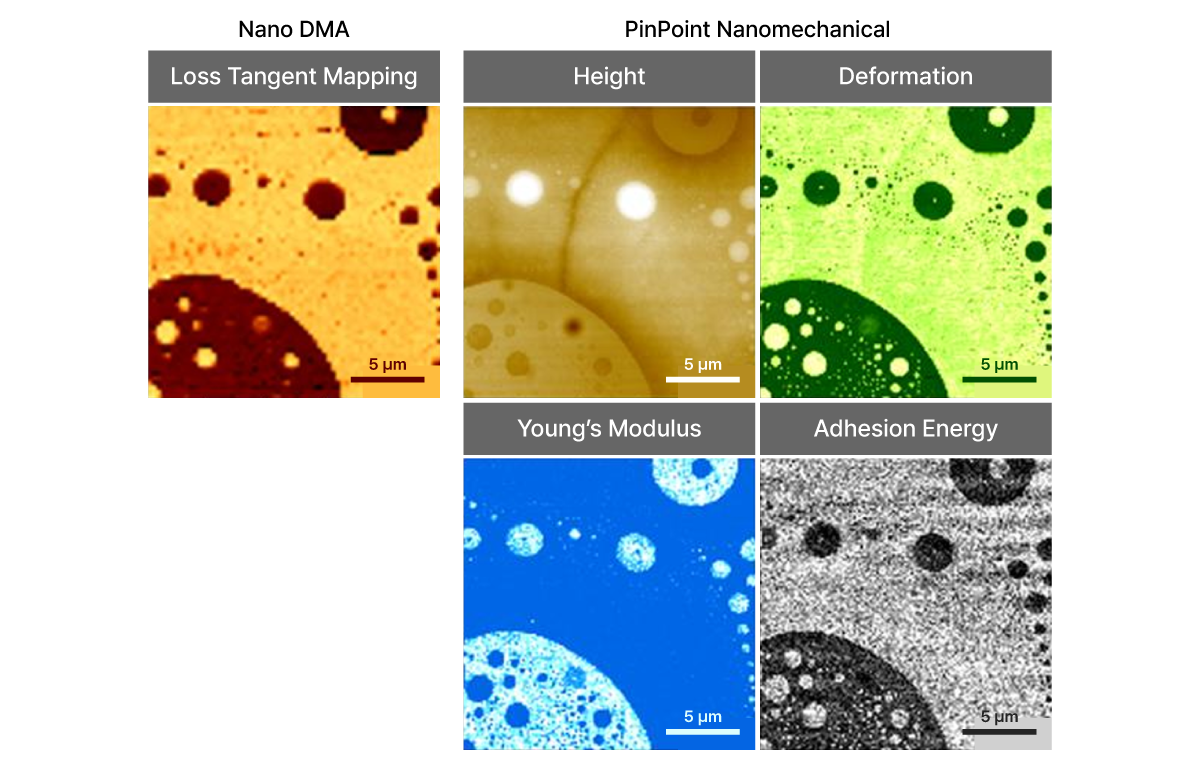
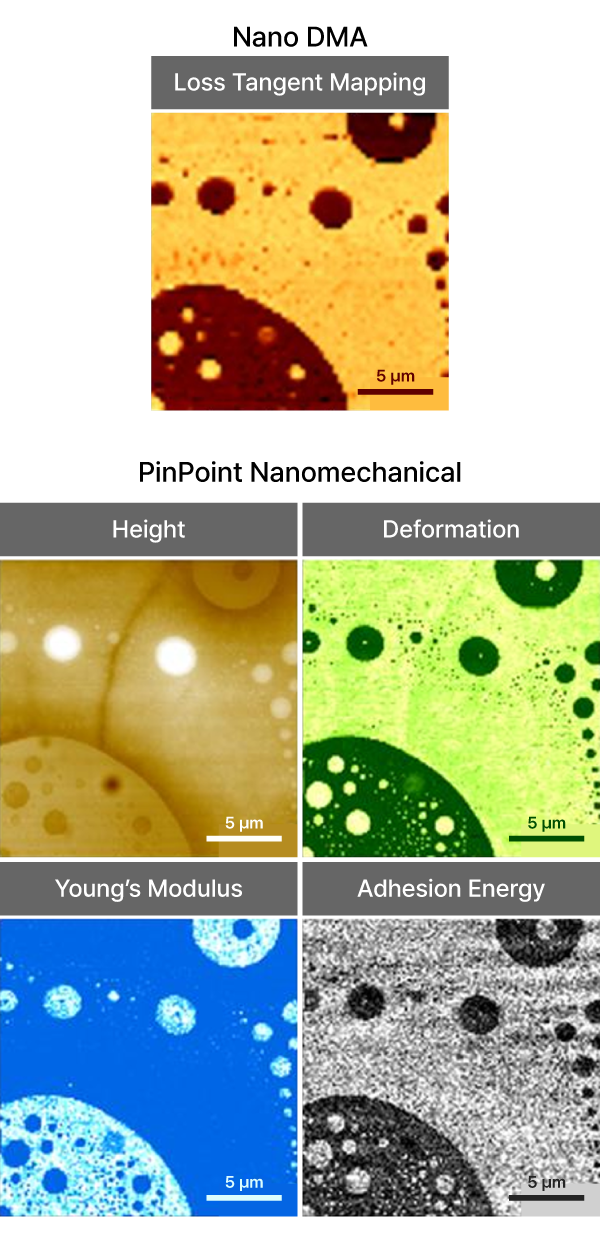
A quantitative analysis of nanoscale mechanical and viscoelastic properties is conducted on a Polystyrene-Low density Polyethylene (PS-LDPE) blend using AFM nanomechanical modes. The same region of the sample surface is examined with both PinPoint nanomechanical mode and nano DMA, enabling a direct comparison of local properties across PS and LDPE domains. PinPoint maps surface topography, stiffness, deformation, and adhesion, revealing PS islands within LDPE and clear mechanical contrasts: PS is stiffer (~GPa range) while LDPE is softer (<1 GPa) with higher adhesion, reflecting its flexibility. Nano DMA quantifies viscoelasticity via loss tangent (tan δ), where PS showed lower tan δ (elastic) and LDPE higher tan δ (viscoelastic). Combined, these methods effectively characterizes polymer heterogeneity and phase-specific properties at the nanoscale.
  • Sample: PS-LDPE
  • System: NX10
  • Scan Size: 20 µm × 20 µm